FastaLake#
Read the FastaLake paper on bioRxiv
Compact protein databases, guided by your spectra.
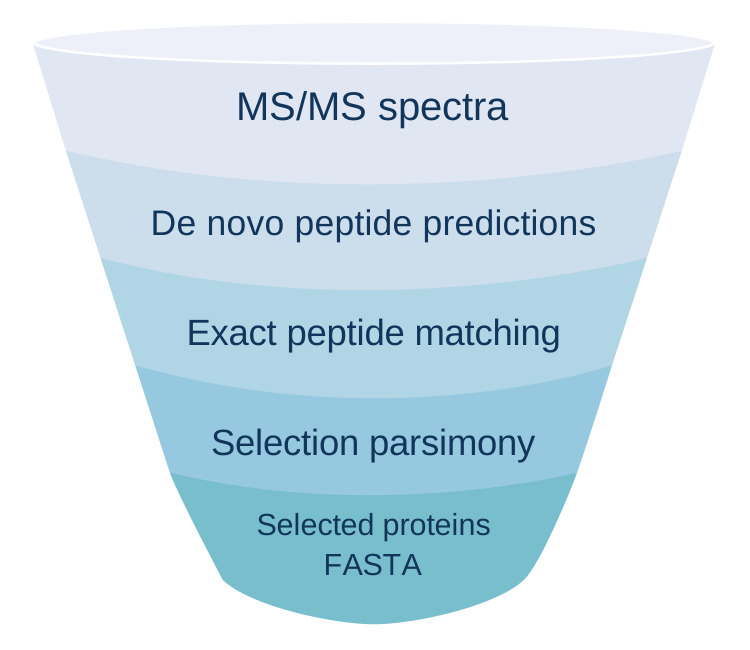
FastaLake uses de novo peptide predictions to select complete proteins from large sequence reservoirs. Search the selected databases with Sage, then group and quantify the peptide evidence across your study.
Install FastaLake Run your first example
What you can do#
- Build an acquisition-specific protein database from public sequence catalogues.
- Run selection, database searching and study-level quantification from a manifest.
- Add matched DNA and RNA evidence when available.
- Use chunked lookup for large reservoirs on smaller machines.
- Explore protein groups, peptide evidence and QC plots.
Start here#
-
Installation
Use the bundled Docker image, install from source, or run on a cluster.
-
Quickstart
Run a small CAMPI example and open your first protein-group matrix.
Bring your own study#
Start with mzML spectra, de novo prediction CSVs and a protein FASTA reservoir. An acquisition manifest connects the files for each sample. RAW conversion and de novo inference happen upstream.
Prepare a manifest · Choose references · Read the results
Learn the method through the visual walkthrough, follow the notebook tutorials, or use a task file with your coding assistant.
Citation and credits#
Cite the exact software version used; CITATION.cff contains the software citation. The manuscript analyses are in fastalake-paper.
FastaLake uses Sage, directLFQ and AlphaPeptTools. Code is MIT licensed; bundled data and dependencies retain their own terms.